


Accredited by the National Association of Testing Authorities
AAMA 501.2-15 Test Procedure
Please note: This is a detailed overview of our AAMA 501.2 test procedure. For more general info about our façade water testing services, click here.
Quality Assurance & Water Leakage Field Check
1 | Overview
The AAMA 501.2 test is a Quality Assurance and Diagnostic Water Leakage Field Check for installed storefronts, building windows, curtain walls, and sloped glazing systems.
It checks the assembly and installation of glazing joints, frames, sealants, and perimeter connections after installation.
This is a field water spray test that identifies potential points of infiltration before building occupancy and interior finishes are applied.
2 | Applicability & Purpose
Applicable to:
Storefront systems
Curtain wall systems
Window walls
Sloped glazing and skylights
Related façade details (perimeter seals, intersections, splices)
Note: Not designed for operable windows or doors. (eg. Sliding doors, awning sashes, etc.)
Purpose:
A diagnostic tool and qualitative assessment to check for leaks and workmanship issues
Provide a standardised field check following construction
Enable remediation before installation of internal finishes and project handover
3 | Test Preparation
3.1 | Select Test Area
Should include:
Vision glass and spandrel glass surfaces
Perimeter caulking and sealant joints
Frame intersections (horizontal/vertical)
Typical internal splices and connections
Note: Interior finishes should be removed or unfinished to allow visual inspection of leaks.
3.2 | Inspect & Clean
Confirm that all systems are fully installed and closed.
Clean test area of debris and temporary protective films that may interfere with water spray or mask leaks.
4 | Equipment & Setup
4.1 | Spray Apparatus
Use a calibrated water spray assembly comprising:
Type B-25 #6.030 brass nozzle with ½″ FPT connection
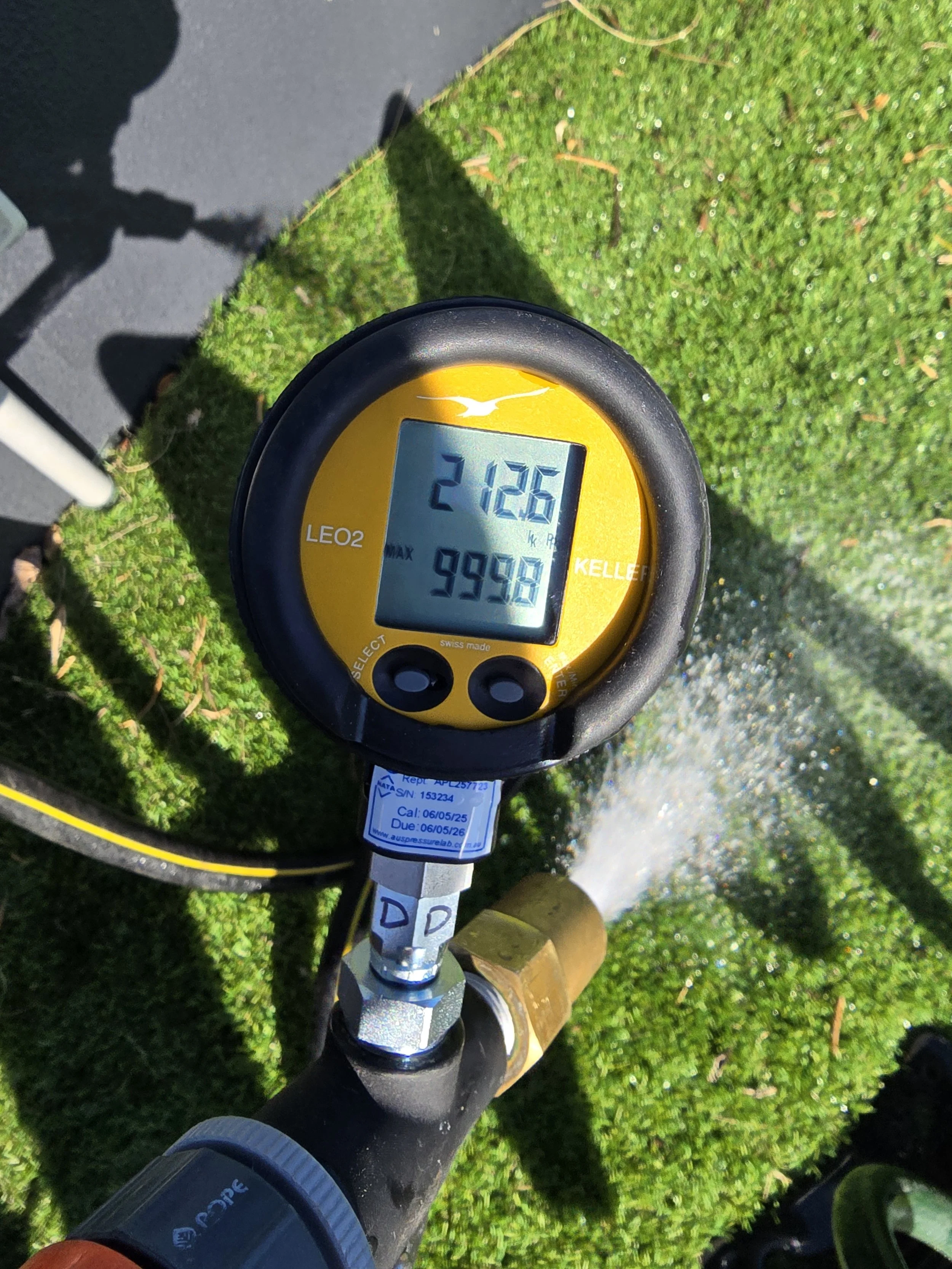
Pressure gauge and control valve
Supply hose
NOTE: the gauge should be calibrated every 6 months to ensure reliable operation
4.2 | Water Pressure
Adjust to 30-35 PSI (207-241kPa) at the nozzle inlet throughout testing unless specified.
4.3 | Nozzle Positioning
Hold nozzle perpendicular (90°) to the façade plane.
Maintain a consistent distance of ~305mm (±25 mm) from the test surface.
5 | Step-by-Step Procedure
Break the test area into 1.5 m long spans of framing.
This helps to manage fatigue of the testers and identify the locations of leaks as the testing progresses.
Each 1.5m section is sprayed continuously for 5 minutes, moving the nozzle slowly back and forth, covering the entire length of the section.
Spraying time is adjusted to suit shorter sections as long as the duration matched 5minutes of testing per 1.5m span ie. 3 minutes for a 0.9m span.
While one technician conducts the testing another technician is inspecting the interior surfaces for water penetration.
6 | Acceptance Criteria
A leak is defined as:
More than 15mLs of uncontrolled water appearing on normally exposed interior surfaces, including water that does not drain back to the exterior
Any uncontrolled water that is not contained or drained back to the exterior, or that can cause damage to adjacent materials or finishes.
Properly drained and contained water within designed flashings is not failure.
7 | Reporting Requirements
A comprehensive test report should include:
Project and location details
Test date, weather conditions, and personnel credentials
Description of tested area and conditions
Water pressure and equipment calibration data
Locations of any leaks and source identification
Photo documentation & recommendations
Compliance statement against the AAMA 501.2 test method
Contact Us
Contact our façade team for expert building envelope testing.
hello@facadetesting.com.au
03 8777 2734
Have questions? Or been specified a different façade testing method (eg. ASTM E1105 or AAMA 502)?
Call or get in touch.